On the eve of a new day (“At last!” some say), a new form—new to this venue, this shadow of the universal Below Dunster, that is—a new form that we hope will usher in, drop by drop, the cool contents of a new era of Dunsterian fecundity.
The dripping spigot lends itself to pith, mirth, and myth alike. It is based on a descending number of syllables in alternating lines (see the boldface) and an ascending syllable count in the other lines (italics):
3 . . absentee
0 . .
2 . . ballots
1 . . are
1 . . in
2 . . demand
0 . .
3 . . great demand
The only other requirement is that the last word of line 6 (which may be the only word of line 6) be repeated as the last word of line 8. It is through this repetition, spilling from line 7’s subtle or screaming silence, that the lightness or the depth of the poem will typically be enforced, and through which the reader, aware or unaware, will absorb the tightness of the artistic piece. [If that last phrase launched in your spleen a fairy backflip (layout, not tuck) of Proustian remembrance, it may be that you have encountered it already on page 52 of Yours Truly’s thesis “Intrusion, Fusion, and Illusion: Vladimir Nabokov and the Artistic Rearrangement of Reality” (a terrible titular denouement following a sonic and semantic tour de force of introductory ascension and the standard colon-peak), where I disagreed with Page Stegner—the same—as to the significance of the number 36 in The Real Life of Sebastian Knight.]
A caveat: newlings may be tempted to disregard lines 2 and 7 of the dripping spigot, as they contain zero syllables, but the essence of the form is captured in the poet’s consideration of these lines. Do not think of them as spaces, but as crucial lines that happen to contain no syllables (for a related, though distinct, phenomenon see “On certain names,” January 23, 2005).
Some examples:
. . . . . .
On, Vixen!
Santa
needs
you
big time
so big time
. . . . . .
Alexis
nectar
of
God’s
meadow
my meadow
. . . . . .
Edelweiss
Trophy
Of
Alp-
En quests
Rugged quests
. . . . . .
Friday, May 05, 2006

chiasthmatic cough XXV
The poet used to be a pauper
The prince plumbs truth’s crevasses
Mules are made with zinc and copper
Brass, by mares and asses.
(technically, a variant of chiasthmatic cough XXIV--with all feminine endings, in honor of the comments under "why I walk," April 15, 2006)
The prince plumbs truth’s crevasses
Mules are made with zinc and copper
Brass, by mares and asses.
(technically, a variant of chiasthmatic cough XXIV--with all feminine endings, in honor of the comments under "why I walk," April 15, 2006)
chiasthmatic cough XXIV
The poet messes with your head
The shrink plumbs truth’s crevasses
Mules are made with white and red
Pink, by mares and asses
The shrink plumbs truth’s crevasses
Mules are made with white and red
Pink, by mares and asses
Wednesday, May 03, 2006
Sonnet to an old friend
(Roman Madly, ever-young Berlinian emigré painter and sometime Dunsterian, best known for his still life Cherries On a Wall)
399psi
penultimacy's apex
Roman, under alien guise excelling
Germanic for thy first eleven years
A merry can of germs at length rebelling
A country or a boy the Birth-marked rears.
Can Ada chronicle thy splintered tree?
Check republics, kingdoms: find it! Will
It ally with a thornclad shrubbery
Hungry for the dust of Europe’s mill?
.
Then mark the soft-striated trunk of Roman
And/or a twig reclining at its base
Slovenly a tick explodes the metaphor—
You crane your beastly neck to see its omen:
Belle jumping where no prince will give her chase
Nor wayward Latin swain has roamed before.
__________________________________
399psi
penultimacy's apex
Roman, under alien guise excelling
Germanic for thy first eleven years
A merry can of germs at length rebelling
A country or a boy the Birth-marked rears.
Can Ada chronicle thy splintered tree?
Check republics, kingdoms: find it! Will
It ally with a thornclad shrubbery
Hungry for the dust of Europe’s mill?
.
Then mark the soft-striated trunk of Roman
And/or a twig reclining at its base
Slovenly a tick explodes the metaphor—
You crane your beastly neck to see its omen:
Belle jumping where no prince will give her chase
Nor wayward Latin swain has roamed before.
__________________________________
Tuesday, May 02, 2006
the lineaments of unfulfilled desire
399chi
oh, for a c-cough! lest like gray Flamel
at last thy long-pneumatic knack
turns from the lee—
Thou art not well!
oh, for a c-cough! in the plumtree dell
oh, for a c-cough! where the sloes excel
'neath Dunster-Old's rheumatic wrack
aching for thee—
It is not well!
oh, for a c-cough! lest like gray Flamel
at last thy long-pneumatic knack
turns from the lee—
Thou art not well!
oh, for a c-cough! in the plumtree dell
for sans that hiasthmatic hack
hale though I be
I am not well!
Monday, May 01, 2006
Sunday, April 30, 2006
Below Yumster
399upsilon

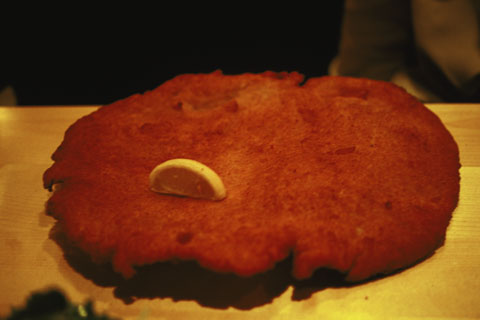
Unbeknownst to many, Wienerschnitzel come with a vertically balanced lemon slice.
Unbeknownster, some also levitate.
Unbeknownst to many, Wienerschnitzel come with a vertically balanced lemon slice.
Unbeknownster, some also levitate.
Saturday, April 29, 2006
Friday, April 28, 2006
Ballad of the Erstwhile Warrior
399sigma
Ballad of the Erstwhile Warrior
An ancient study in slant rhyme
In days when monarchs were the norm
And weapons were of mettle
There was a man whose nerves were too
And led men into battle
He had slain lions, bears, a giant
Without the aid of sword
And co-fleshed with the king’s own seed:
His bravery’s reward
Years later, having grown and wised
He scored his in-law’s office
And stoutly governed his domain
And won the land great profits
His military tact and wile
Shame those of Scipio
While his charisma was the model
Employed by Cicero
But in this tale of his great fall
Kings’ armies hardly move-
The real battle lines were drawn
To sabotage true love:
Our king stood where he should have not
For while his men were dying
He promenaded on the roof
Their bathing wives espying
Seeing one that looked appealing
He summoned her with speed
They quickly rounded second base
And soon had done the deed
The king thought naught of it while he
Relaxed his male segment
But he was newly petrified
On hearing she was pregnant
About this time, her husband came
To bring news from the war
“Sir, our prospects are tremendous,
Just one fight or two more.”
Now, this man and the king were partners
Almost from pubescence
But since the wife now had been too
A plan was of the essence
“Go home and rest with your dear wife,”
Said King to cloak his fumble
(Surely he’ll think the child is his
After they sleep ensemble)
But hardly had the king expected
His soldier’s noble care
“My brothers lie on stones,” he said
And slept out on the stairs
At this the king was straight distraught
He knew his plan was foiled
In haste a new one he devised
This time better oiled
He wrote a letter, gave it him
Upon the man’s departure
“Take this to the general, please,
Sure-footed speedy marcher”
The man obeyed, not ever guessing
The sentence that it hid
For in the letter stood the words
“Make sure he doesn’t live”
The general, following the order
Placed him far ahead
Soon he was fighting all alone
And finally he was dead
The noble soldier never knew
He’d lost more than his life—
The same man who had taken that
Also had his wife
The king, with little time elapsed
Made the dame his bride
Then, like his virtue and her ex
Their newborn promptly died.
Ballad of the Erstwhile Warrior
An ancient study in slant rhyme
In days when monarchs were the norm
And weapons were of mettle
There was a man whose nerves were too
And led men into battle
He had slain lions, bears, a giant
Without the aid of sword
And co-fleshed with the king’s own seed:
His bravery’s reward
Years later, having grown and wised
He scored his in-law’s office
And stoutly governed his domain
And won the land great profits
His military tact and wile
Shame those of Scipio
While his charisma was the model
Employed by Cicero
But in this tale of his great fall
Kings’ armies hardly move-
The real battle lines were drawn
To sabotage true love:
Our king stood where he should have not
For while his men were dying
He promenaded on the roof
Their bathing wives espying
Seeing one that looked appealing
He summoned her with speed
They quickly rounded second base
And soon had done the deed
The king thought naught of it while he
Relaxed his male segment
But he was newly petrified
On hearing she was pregnant
About this time, her husband came
To bring news from the war
“Sir, our prospects are tremendous,
Just one fight or two more.”
Now, this man and the king were partners
Almost from pubescence
But since the wife now had been too
A plan was of the essence
“Go home and rest with your dear wife,”
Said King to cloak his fumble
(Surely he’ll think the child is his
After they sleep ensemble)
But hardly had the king expected
His soldier’s noble care
“My brothers lie on stones,” he said
And slept out on the stairs
At this the king was straight distraught
He knew his plan was foiled
In haste a new one he devised
This time better oiled
He wrote a letter, gave it him
Upon the man’s departure
“Take this to the general, please,
Sure-footed speedy marcher”
The man obeyed, not ever guessing
The sentence that it hid
For in the letter stood the words
“Make sure he doesn’t live”
The general, following the order
Placed him far ahead
Soon he was fighting all alone
And finally he was dead
The noble soldier never knew
He’d lost more than his life—
The same man who had taken that
Also had his wife
The king, with little time elapsed
Made the dame his bride
Then, like his virtue and her ex
Their newborn promptly died.
Thursday, April 27, 2006
chiasthmatic cough XXIII
The poet has a (Cretan) dream
El Greco, beef with Nyx
Casanova picks up steam
The locomotive, chicks.
El Greco, beef with Nyx
Casanova picks up steam
The locomotive, chicks.
I have a (Cretan) dream
399rho
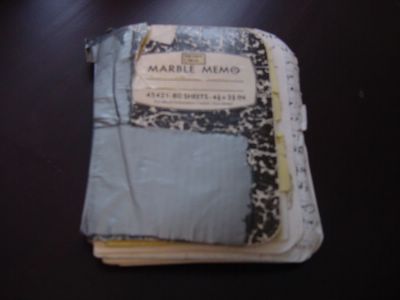
April 13, 2004: this little book, whose real-life blurriness is faithfully preserved in the above picture, receives its first entry. The subject is one Theodore (or Theodrin, or Theoden, or Theops, or Theoprecedesthep, or perhaps simply Theo, after all; no one is quite sure) Tokopoulos, a man of my invention whose name is based on that of Domenikos Theotokopoulos, better known as El Greco. I was thinking about El Greco, I remember, because of a scene in Nabokov’s Ada, Or Ardor: A Family Chronicle that refers to El Greco’s painting “The Cretan Dream” in the context of a bizarre love triangle being described not emotionally but spatially, yea, geometrically, i.e., as an actual triangle.
April 27, 2006: Two years and two weeks later, the same little book (having lain fallow, with Below Dunster, for 399) receives its last entry, something about halving infinity, which had to do, in the middle of the night, with—guess whom—El Greco. The middle-of-nightness, the evolution of the El Greco theme, and the conviction that, of all the things that are tough to do, “picking up steam” must be one of the toughest (keeps slipping through your fingers), inspired and formed the skeleton of a c-cough whose eventual form can be seen in the next post.
Another dream during the same night involved a game of trilingual Scrabble (in English, French, and Russian, though I do not speak the latter) in which Lucette’s KREMLIN was disallowed not for being a proper name but for having been coined by a Frenchman—apparently at this stage that man’s language had faded out of the dream and the game. Thus a kickball entered, under my own boot and in reverse (yes, spheres can roll in reverse) a vermin-trapping cage of the kind in which I saw a raccoon perish in an Oregon barn when I was Lucette’s age; this time, though, the scene was the edge/bank (Lat. ripa) of Hogwarts Lake with the ghost of Ada still hovering about as Snape (my best mate) approached asymptotically, never fully to arrive. The whole thing, I tenderly recall, transpired to a soundtrack of the trance hit “Revelation” by 4 Strings.
You can tell this dream is authentic because the made-up kind always make sense. They are symbolic to the max, fraught with Potterian plainness and receiving a facile denouement later in the tale. Such dreams do not make it Below Dunster.
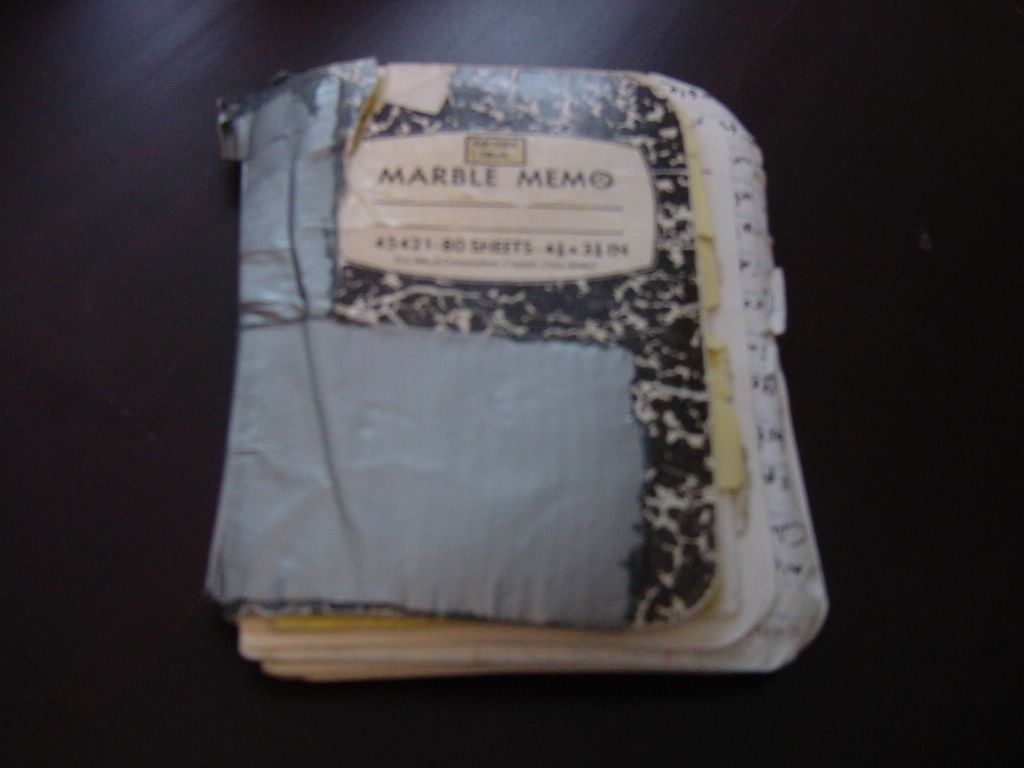
April 13, 2004: this little book, whose real-life blurriness is faithfully preserved in the above picture, receives its first entry. The subject is one Theodore (or Theodrin, or Theoden, or Theops, or Theoprecedesthep, or perhaps simply Theo, after all; no one is quite sure) Tokopoulos, a man of my invention whose name is based on that of Domenikos Theotokopoulos, better known as El Greco. I was thinking about El Greco, I remember, because of a scene in Nabokov’s Ada, Or Ardor: A Family Chronicle that refers to El Greco’s painting “The Cretan Dream” in the context of a bizarre love triangle being described not emotionally but spatially, yea, geometrically, i.e., as an actual triangle.
April 27, 2006: Two years and two weeks later, the same little book (having lain fallow, with Below Dunster, for 399) receives its last entry, something about halving infinity, which had to do, in the middle of the night, with—guess whom—El Greco. The middle-of-nightness, the evolution of the El Greco theme, and the conviction that, of all the things that are tough to do, “picking up steam” must be one of the toughest (keeps slipping through your fingers), inspired and formed the skeleton of a c-cough whose eventual form can be seen in the next post.
Another dream during the same night involved a game of trilingual Scrabble (in English, French, and Russian, though I do not speak the latter) in which Lucette’s KREMLIN was disallowed not for being a proper name but for having been coined by a Frenchman—apparently at this stage that man’s language had faded out of the dream and the game. Thus a kickball entered, under my own boot and in reverse (yes, spheres can roll in reverse) a vermin-trapping cage of the kind in which I saw a raccoon perish in an Oregon barn when I was Lucette’s age; this time, though, the scene was the edge/bank (Lat. ripa) of Hogwarts Lake with the ghost of Ada still hovering about as Snape (my best mate) approached asymptotically, never fully to arrive. The whole thing, I tenderly recall, transpired to a soundtrack of the trance hit “Revelation” by 4 Strings.
You can tell this dream is authentic because the made-up kind always make sense. They are symbolic to the max, fraught with Potterian plainness and receiving a facile denouement later in the tale. Such dreams do not make it Below Dunster.
Wednesday, April 26, 2006
Tuesday, April 25, 2006
Exhibit Yod
AD 2006: The following fragment of an undated memoir is discovered Below Dunster, the text of which we feel it is our duty to make available, rendering the apparently tellworthy events of a particular waning afternoon (judging from the second portion) at DuPont Circle, that nonpareil of D.C. traffic foci. We have reason to believe the originator’s mother tongue was not English but perhaps an otherwise lost language of the Finno-Ugric group, a Nordic pidgin of some sort, or even Esperanto. One thing is certain: he knows his Kipling.
The account begins, we further believe, at the precise moment that witnessed the I alighting on a bench on the Circle’s south side (determined ostsüdometrically), facing in.
Across the circle, a hemp-clad couplet was juggling bowling pins back and forth in a jolly attestation to hippie immortality, and a dumb crowd was gathering to let its toddlers kink their otherwise soft and limber necks in the manner they had learned from their white aristocratic uncles Herbert, Marvin, and Rob, the tennis fanatics. From my bench a flimsy Frisbee flip away, my scrutiny rested at first with the male hippie alone, whose too-long tee-shirt drably concealed a treasure map of moles maculating his upper back, in texture like that of a bovine snout spanned across an equine flank, and in front, the classic concave chest commonly connected with runners of cross-country. Though presumably attached to this, his arms were of the thickest-at-the-elbow type that look as though they may actually originate at the sleeve’s end (due mostly to the latter’s seeming vacancy), mystically remaining tethered to the torso. He belonged to the scattered class of curious bipeds who, if not for the rudely protruding head, would appear the same standing on their hands as on their feet, rendering redundant any description of the sub-stomach region, and though the lawn obscured his feet, I knew he was the kind of person of whom it is superfluous to say he wore no shoes. The juggler, meanwhile, who could perhaps have passed for an engineer-in-training but for those silly pins, was transfigured by his newfound local—very local—fame, and the almost certain anarchistic antics of his mind partied hard behind a strained and pasty grin derived from some invisible horse bit, commandeered by the little gremlin (also unseeable) perched upon his scapula. This hippie smiled tautly, and tossed smoothly, until his broad-lipped fixedness stretched and blurred the scene into one gyrating Gestalt; watched and watcher alike formed the periphery of a fuzzy, fulgent fan-belt in the air, whose lemniscate flutter and waft set me in a weak trance, and Mogli, had Kaa employed this method, would have in a minute been mere python meat.
Discarding that toothsome image, let us consider other curios. Note how the She, the woman partner, has not been noticed or described. It may be that my She-bound eyebeam was impeded by an obese auntie (Marvin’s Missus?); perhaps the second juggler was small or even Lilliputian, although the pins’ trajectory testified otherwise. Unblocked, the gaze of Yours Truly might have registered the jugglerette’s navy hooded sweatshirt with the logo of some obscure non-brand, and vertically striped hemp trousers whose aesthetic infirmity was not quite mitigated by self-applied marks of ball-point pen from the ankles, which were actually at mid-calf, to the pockets bulging with homemade hacky sacks. She had, I am sure, short hair arranged like the tuft on a Bactrian camel’s front hump, and may have shared other features with that beast. Whether she smiled, I do not know. I picture that, if corresponding points on the two jugglers’ lips were joined by unseen thread, the outer corners of her lips must have flared forward like the mouth of a manta ray, the center sucked tight to her incisors, and from this contortion it would not be unconservative to conclude that her jockey-gremlin counterpart was either feeble-armed or absent. But in all likelihood her mouth did nothing of the sort; I, for one, have never witnessed such a horn-lipped visage, and the thought of one is absurd to the reasonable mind. What matters is that she formed the other focus of the projectile path, that she, together with the engineer hippie, whipped into motion the pin piston that now seemed to generate the very traffic of DuPont Circle, forming the eye of a locomotive hurricane so convincing that mixers of metaphors searched the sky for smoke, and half expected a red—no, rainbow—caboose to putt-putt by at any moment.
A pin dropped (one could not hear it) in the cushy grass, and the train stopped, with not nearly so catastrophic consequences as one might have feared: DuPont traffic rambled on, the sky was smokeless as before, and the caboose held fast on page four of Generic Children’s Book. How tenderly do I recall my first edition of Der Zug mit Sommersprossen (The Freckled Train), that great treatise of underdog vigor, that paragon of pedagogical publications, that Solomon of children’s literature! Faith, all other kiddie books are pale copies, impish impostors that should have long been burned by Bradbury’s loyal firemen! Erzähler, verberge dich; narrateur, cache-toi! Apologies; yes, the jugglers: evidently they were nice people or wackos, because they were now teaching a girl of eight or so, named Mindy or Haley, how to juggle. I cannot imagine a person named Mindy or Haley being able to juggle—well, maybe Haley; let us hope her name was Haley—but it is in the nature of hippies to try and teach the intractable and convince the inexorable. Ah, her name was Mindy.
In a Sadist moment that I could not help, I previewed the hilarity of one partner intentionally making a bad toss, perhaps at the other’s knee or pancreas. “Hippie rushed to Georgetown Hospital after taking bowling bin to pancreas, pot spared.” It was then that I vowed not to perish before ascertaining the actual shape and function of the pancreas. “Man goes to grave with not a clue of pancreases”—let it not be so! Or was it pancreae? I must survive to extirpate this trivium, too. O Death, strike not soon!
Sadism subsiding, I recognized for the first time another aspect of the juggling, the aspect which a writer of so-called Romance might have called “the dance” (I would rather have a permanent dull pain administered to my brachial nerve than beschmutz my eyes with such artless blather; I would not even wipe myself with its recycled pages, or accoutre my cute gerbil’s dwelling)—but I need not call it that, nor need I give it any name; let us simply see me responding to the skillful interplay, the kindly kindling of a trade route that lent the pins a highway and the hippies meaning, for without a prop of some sort a hippie gropes in vain for meaning. I saw the balanced reciprocity of tosses, a fond exchange between accomplices of such intimacy that plastic cylinders could serve as words, sidekicks of such security that they would burn so much organic fuel for an act in which, technically speaking, not a blessed Joule of work was done.
“O hippie pot among us,” I cried,
“Let thy fumes infuse us with this amity;
O cormorant, be distant,
O oxpecker, adjacent;
Share with us all thy symbiotic mystery!”
[Here a lacuna of unalarming magnitude interrupts the manuscript] Suddenly
The original Marathoner, Henry Thoreau, and Truly Yours
Were sitting in the Circle in a circle
(If three can make one)
Contemplating breakdance.
I know two out of three are dead already,
But give the story a chance.
Henry David said to stand a chance
You have to take the beat and make it yours.
That I knew already,
So I laid the beat down on his circul-
arity. Henry thought it was a breakdance
Move, so I said, “Sure, the Walden Pound—a new one.”
The fact is, no more than one
In 42,000 (meters) gets the chance
To transcend the Vanilla Ice visage of breakdance—
If it’s you, the charge is yours
To run the news outside the Nike circle;
The Marathoner’s shown you how already.
Of course, he fell when he had finished, and we’re not all ready
To do that. At this point Henry butted back in with one
Of his not-sure-whether-to-laugh-or-kick-him-out-of-the-circle
(And the Circle)
Statements: “Just give Greece a chance.”
Mr. Marathon quipped, “We had it, used it well, and now it’s yours;
Quit musing, pond-man, and breakdance.”
It quickly was confirmed the man knew nothing of breakdance
(Another thing I felt I knew already),
So I stated my opinion, then asked the Greek, “what’s yours?”
“Disregarding Henry,” he replied, “there is no one
So clumsy. Now, my boy, it’s your chance.”
And I stepped into the circle.
When I did, up from the circle
Leapt the leprechauns of breakdance,
Lending silver-footedness and chance,
That coupled with the spunk I had already
(Yes, three can make one!)
To forge a feat of motion that I wish I could make yours.
When I looked up, Henry had found his chance to leave already.
As for breakdance in the circle, the only dancer left was Truly Yours;
The Greek had run off to report the victory was won.
The account begins, we further believe, at the precise moment that witnessed the I alighting on a bench on the Circle’s south side (determined ostsüdometrically), facing in.
Across the circle, a hemp-clad couplet was juggling bowling pins back and forth in a jolly attestation to hippie immortality, and a dumb crowd was gathering to let its toddlers kink their otherwise soft and limber necks in the manner they had learned from their white aristocratic uncles Herbert, Marvin, and Rob, the tennis fanatics. From my bench a flimsy Frisbee flip away, my scrutiny rested at first with the male hippie alone, whose too-long tee-shirt drably concealed a treasure map of moles maculating his upper back, in texture like that of a bovine snout spanned across an equine flank, and in front, the classic concave chest commonly connected with runners of cross-country. Though presumably attached to this, his arms were of the thickest-at-the-elbow type that look as though they may actually originate at the sleeve’s end (due mostly to the latter’s seeming vacancy), mystically remaining tethered to the torso. He belonged to the scattered class of curious bipeds who, if not for the rudely protruding head, would appear the same standing on their hands as on their feet, rendering redundant any description of the sub-stomach region, and though the lawn obscured his feet, I knew he was the kind of person of whom it is superfluous to say he wore no shoes. The juggler, meanwhile, who could perhaps have passed for an engineer-in-training but for those silly pins, was transfigured by his newfound local—very local—fame, and the almost certain anarchistic antics of his mind partied hard behind a strained and pasty grin derived from some invisible horse bit, commandeered by the little gremlin (also unseeable) perched upon his scapula. This hippie smiled tautly, and tossed smoothly, until his broad-lipped fixedness stretched and blurred the scene into one gyrating Gestalt; watched and watcher alike formed the periphery of a fuzzy, fulgent fan-belt in the air, whose lemniscate flutter and waft set me in a weak trance, and Mogli, had Kaa employed this method, would have in a minute been mere python meat.
Discarding that toothsome image, let us consider other curios. Note how the She, the woman partner, has not been noticed or described. It may be that my She-bound eyebeam was impeded by an obese auntie (Marvin’s Missus?); perhaps the second juggler was small or even Lilliputian, although the pins’ trajectory testified otherwise. Unblocked, the gaze of Yours Truly might have registered the jugglerette’s navy hooded sweatshirt with the logo of some obscure non-brand, and vertically striped hemp trousers whose aesthetic infirmity was not quite mitigated by self-applied marks of ball-point pen from the ankles, which were actually at mid-calf, to the pockets bulging with homemade hacky sacks. She had, I am sure, short hair arranged like the tuft on a Bactrian camel’s front hump, and may have shared other features with that beast. Whether she smiled, I do not know. I picture that, if corresponding points on the two jugglers’ lips were joined by unseen thread, the outer corners of her lips must have flared forward like the mouth of a manta ray, the center sucked tight to her incisors, and from this contortion it would not be unconservative to conclude that her jockey-gremlin counterpart was either feeble-armed or absent. But in all likelihood her mouth did nothing of the sort; I, for one, have never witnessed such a horn-lipped visage, and the thought of one is absurd to the reasonable mind. What matters is that she formed the other focus of the projectile path, that she, together with the engineer hippie, whipped into motion the pin piston that now seemed to generate the very traffic of DuPont Circle, forming the eye of a locomotive hurricane so convincing that mixers of metaphors searched the sky for smoke, and half expected a red—no, rainbow—caboose to putt-putt by at any moment.
A pin dropped (one could not hear it) in the cushy grass, and the train stopped, with not nearly so catastrophic consequences as one might have feared: DuPont traffic rambled on, the sky was smokeless as before, and the caboose held fast on page four of Generic Children’s Book. How tenderly do I recall my first edition of Der Zug mit Sommersprossen (The Freckled Train), that great treatise of underdog vigor, that paragon of pedagogical publications, that Solomon of children’s literature! Faith, all other kiddie books are pale copies, impish impostors that should have long been burned by Bradbury’s loyal firemen! Erzähler, verberge dich; narrateur, cache-toi! Apologies; yes, the jugglers: evidently they were nice people or wackos, because they were now teaching a girl of eight or so, named Mindy or Haley, how to juggle. I cannot imagine a person named Mindy or Haley being able to juggle—well, maybe Haley; let us hope her name was Haley—but it is in the nature of hippies to try and teach the intractable and convince the inexorable. Ah, her name was Mindy.
In a Sadist moment that I could not help, I previewed the hilarity of one partner intentionally making a bad toss, perhaps at the other’s knee or pancreas. “Hippie rushed to Georgetown Hospital after taking bowling bin to pancreas, pot spared.” It was then that I vowed not to perish before ascertaining the actual shape and function of the pancreas. “Man goes to grave with not a clue of pancreases”—let it not be so! Or was it pancreae? I must survive to extirpate this trivium, too. O Death, strike not soon!
Sadism subsiding, I recognized for the first time another aspect of the juggling, the aspect which a writer of so-called Romance might have called “the dance” (I would rather have a permanent dull pain administered to my brachial nerve than beschmutz my eyes with such artless blather; I would not even wipe myself with its recycled pages, or accoutre my cute gerbil’s dwelling)—but I need not call it that, nor need I give it any name; let us simply see me responding to the skillful interplay, the kindly kindling of a trade route that lent the pins a highway and the hippies meaning, for without a prop of some sort a hippie gropes in vain for meaning. I saw the balanced reciprocity of tosses, a fond exchange between accomplices of such intimacy that plastic cylinders could serve as words, sidekicks of such security that they would burn so much organic fuel for an act in which, technically speaking, not a blessed Joule of work was done.
“O hippie pot among us,” I cried,
“Let thy fumes infuse us with this amity;
O cormorant, be distant,
O oxpecker, adjacent;
Share with us all thy symbiotic mystery!”
[Here a lacuna of unalarming magnitude interrupts the manuscript] Suddenly
The original Marathoner, Henry Thoreau, and Truly Yours
Were sitting in the Circle in a circle
(If three can make one)
Contemplating breakdance.
I know two out of three are dead already,
But give the story a chance.
Henry David said to stand a chance
You have to take the beat and make it yours.
That I knew already,
So I laid the beat down on his circul-
arity. Henry thought it was a breakdance
Move, so I said, “Sure, the Walden Pound—a new one.”
The fact is, no more than one
In 42,000 (meters) gets the chance
To transcend the Vanilla Ice visage of breakdance—
If it’s you, the charge is yours
To run the news outside the Nike circle;
The Marathoner’s shown you how already.
Of course, he fell when he had finished, and we’re not all ready
To do that. At this point Henry butted back in with one
Of his not-sure-whether-to-laugh-or-kick-him-out-of-the-circle
(And the Circle)
Statements: “Just give Greece a chance.”
Mr. Marathon quipped, “We had it, used it well, and now it’s yours;
Quit musing, pond-man, and breakdance.”
It quickly was confirmed the man knew nothing of breakdance
(Another thing I felt I knew already),
So I stated my opinion, then asked the Greek, “what’s yours?”
“Disregarding Henry,” he replied, “there is no one
So clumsy. Now, my boy, it’s your chance.”
And I stepped into the circle.
When I did, up from the circle
Leapt the leprechauns of breakdance,
Lending silver-footedness and chance,
That coupled with the spunk I had already
(Yes, three can make one!)
To forge a feat of motion that I wish I could make yours.
When I looked up, Henry had found his chance to leave already.
As for breakdance in the circle, the only dancer left was Truly Yours;
The Greek had run off to report the victory was won.
VN, Part II; or, Fun With Humbert
399omikron
Humbert, spittle on my cake, fire in my oven. Hum-bert. The tip of the tongue doing mostly nothing, sitting tight for a nervous mumble and belch, letting the lesser epiglottis usher the stubborn air over the retreating tongue-top to stop at the lip: a flopped potty-break leaving the tongue little to do but check the schwa before the stench escapes.
Humbert, spittle on my cake, fire in my oven. Hum-bert. The tip of the tongue doing mostly nothing, sitting tight for a nervous mumble and belch, letting the lesser epiglottis usher the stubborn air over the retreating tongue-top to stop at the lip: a flopped potty-break leaving the tongue little to do but check the schwa before the stench escapes.
Monday, April 24, 2006
Exhibit Tet
399xi
AD 1564: Around this day, William Shakspere (Shaxpere, Shaksper, Shakespear, Shake-speare, Shakespeare, etc.), the Bard himself, is born in Stratford-upon-Avon. “Around this day,” because it must be extrapolated from his baptism, which took place on April 26, and these usually took place a few days after birth (to clear the little nippers of that nasty original sin before they died in infancy). Shakspere’s birthday is usually fixed to the 23rd, but this is mainly in order to create a memorable, eerie, and artificial symmetry with his deathday, April 23, 1616. (Those of you who frequent Below Dunster know what we think of artificial symmetry and contrived coincidences.) Thus we have decided to stray deliberately from the 23rd-tradition and to exhibit on the—quite possibly more likely—24th.
Vladimir Nabokov—the Other Bard, in Below Dunster’s reliable opinion—speaks of Shakspere’s birthday as were it undisputedly on April 22, but this is only because his own birthday was April 22, 1899. For this bit of arrogant calendrical tomfoolery VN has been duly punished by having his birthday reference omitted from Below Dunster’s April 22 posts. For a rather better bit of sleight of hand, Exhibit Tet honors him nonetheless by duplicating here, in full, his ode to Shakspere. Written in Russian in 1924, it was translated into English by Dmitri when Yours Truly was in the first grade. We have elected to display the English version here, which makes no clearer than the Russian what was Nabokov’s stance on the true origin of Shakspere’s opera:
Shakespeare
Amid grandees of times Elizabethan
you shimmered too, you followed sumptuous custom;
the circle of ruff, the silv'ry satin that
encased your thigh, the wedgelike beard - in all of this
you were like other men. Thus was enfolded
your godlike thunder in a succinct cape.
Haughty, aloof from theatre's alarums,
you easily, regretlessly relinquished
the laurels twinning into a dry wreath,
concealing for all time your monstrous genius
beneath a mask; and yet, your phantasm's echoes
still vibrate for us; your Venetian Moor,
his anguish; Falstaff's visage, like an udder
with pasted-on mustache; the raging Lear.
You are among us, you're alive; your name, though,
your image, too - deceiving, thus, the world
you have submerged in your beloved Lethe.
It's true, of course, a usurer had grown
accustomed, for a sum, to sign your work
(that Shakespeare - Will - who played the Ghost in Hamlet,
who lives in pubs, and died before he could
digest in full his portion of a boar's head)...
The frigate breathed, your country you were leaving.
To Italy you went. A female voice
called singsong through the iron's pattern
called to her balcony the tall inglesse,
grown languid from the lemon-tinted moon
and Verona's streets. My inclination is
to imagine, possibly, the droll
and kind creator of Don Quixote
exchanging with you a few casual words
while waiting for fresh horses - and the evening
was surely blue. The well behind the tavern
contained a pail's pure tinkling sound... Reply
whom did you love? Reveal yourself - whose memoirs
refer to you in passing? Look what numbers
of lowly, worthless souls have left their trace,
what countless names Brantome has for the asking!
Reveal yourself, god of iambic thunder,
you hundred-mouthed, unthinkably great bard!
No! At the destined hour, when you felt banished
by God from your existence, you recalled
those secret manuscripts, fully aware
that your supremacy would rest unblemished
by public rumor's unashamed brand,
that ever, midst the shifting dust of ages,
faceless you'd stay, like immortality
itself - then vanished in the distance, smiling.
Copyright 1979 Vladimir Nabokov Estate
English version copyright 1988 Dmitri Nabokov
AD 1564: Around this day, William Shakspere (Shaxpere, Shaksper, Shakespear, Shake-speare, Shakespeare, etc.), the Bard himself, is born in Stratford-upon-Avon. “Around this day,” because it must be extrapolated from his baptism, which took place on April 26, and these usually took place a few days after birth (to clear the little nippers of that nasty original sin before they died in infancy). Shakspere’s birthday is usually fixed to the 23rd, but this is mainly in order to create a memorable, eerie, and artificial symmetry with his deathday, April 23, 1616. (Those of you who frequent Below Dunster know what we think of artificial symmetry and contrived coincidences.) Thus we have decided to stray deliberately from the 23rd-tradition and to exhibit on the—quite possibly more likely—24th.
Vladimir Nabokov—the Other Bard, in Below Dunster’s reliable opinion—speaks of Shakspere’s birthday as were it undisputedly on April 22, but this is only because his own birthday was April 22, 1899. For this bit of arrogant calendrical tomfoolery VN has been duly punished by having his birthday reference omitted from Below Dunster’s April 22 posts. For a rather better bit of sleight of hand, Exhibit Tet honors him nonetheless by duplicating here, in full, his ode to Shakspere. Written in Russian in 1924, it was translated into English by Dmitri when Yours Truly was in the first grade. We have elected to display the English version here, which makes no clearer than the Russian what was Nabokov’s stance on the true origin of Shakspere’s opera:
Shakespeare
Amid grandees of times Elizabethan
you shimmered too, you followed sumptuous custom;
the circle of ruff, the silv'ry satin that
encased your thigh, the wedgelike beard - in all of this
you were like other men. Thus was enfolded
your godlike thunder in a succinct cape.
Haughty, aloof from theatre's alarums,
you easily, regretlessly relinquished
the laurels twinning into a dry wreath,
concealing for all time your monstrous genius
beneath a mask; and yet, your phantasm's echoes
still vibrate for us; your Venetian Moor,
his anguish; Falstaff's visage, like an udder
with pasted-on mustache; the raging Lear.
You are among us, you're alive; your name, though,
your image, too - deceiving, thus, the world
you have submerged in your beloved Lethe.
It's true, of course, a usurer had grown
accustomed, for a sum, to sign your work
(that Shakespeare - Will - who played the Ghost in Hamlet,
who lives in pubs, and died before he could
digest in full his portion of a boar's head)...
The frigate breathed, your country you were leaving.
To Italy you went. A female voice
called singsong through the iron's pattern
called to her balcony the tall inglesse,
grown languid from the lemon-tinted moon
and Verona's streets. My inclination is
to imagine, possibly, the droll
and kind creator of Don Quixote
exchanging with you a few casual words
while waiting for fresh horses - and the evening
was surely blue. The well behind the tavern
contained a pail's pure tinkling sound... Reply
whom did you love? Reveal yourself - whose memoirs
refer to you in passing? Look what numbers
of lowly, worthless souls have left their trace,
what countless names Brantome has for the asking!
Reveal yourself, god of iambic thunder,
you hundred-mouthed, unthinkably great bard!
No! At the destined hour, when you felt banished
by God from your existence, you recalled
those secret manuscripts, fully aware
that your supremacy would rest unblemished
by public rumor's unashamed brand,
that ever, midst the shifting dust of ages,
faceless you'd stay, like immortality
itself - then vanished in the distance, smiling.
Copyright 1979 Vladimir Nabokov Estate
English version copyright 1988 Dmitri Nabokov
Sunday, April 23, 2006
Saturday, April 22, 2006
you do the maff
(399mu)
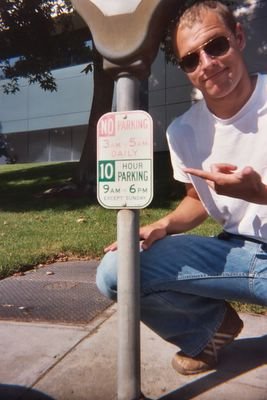
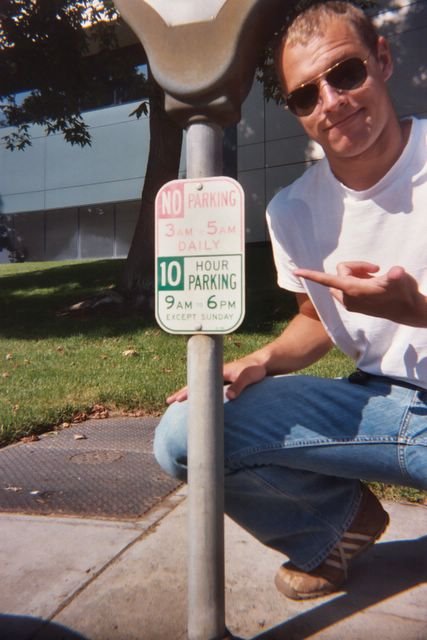
Maybe--just maybe--to the city's credit, what is in the green box is not the number it resembles perfectly. Maybe it is simply an introductory formula: "lo," as in "lo and behold," heralding the imminence of Hour Parking. This would also create a primitive, but nevertheless cute, rhyme with the red box's contents as well.
Alternatively, this could be an oblique reference to Jupiter's fourth (in Galileo's reckoning; I believe the count is now at sixty-three) and shortest-named satellite, Io, or to the eponymous Greek maiden, who was transmogrified into a heifer by Zeus (a.k.a. Jupiter; the symmetry should not be alarming, as all four of Galileo's Jovian moons are named for paramours of that lubricious god-father) to hide her from a jealous Hera. Santa Monica has always revered the Classics.
Later, perhaps, we will consider the possibility that this space is specially designed for time-warp vehicles.
Maybe--just maybe--to the city's credit, what is in the green box is not the number it resembles perfectly. Maybe it is simply an introductory formula: "lo," as in "lo and behold," heralding the imminence of Hour Parking. This would also create a primitive, but nevertheless cute, rhyme with the red box's contents as well.
Alternatively, this could be an oblique reference to Jupiter's fourth (in Galileo's reckoning; I believe the count is now at sixty-three) and shortest-named satellite, Io, or to the eponymous Greek maiden, who was transmogrified into a heifer by Zeus (a.k.a. Jupiter; the symmetry should not be alarming, as all four of Galileo's Jovian moons are named for paramours of that lubricious god-father) to hide her from a jealous Hera. Santa Monica has always revered the Classics.
Later, perhaps, we will consider the possibility that this space is specially designed for time-warp vehicles.
Subscribe to:
Posts (Atom)